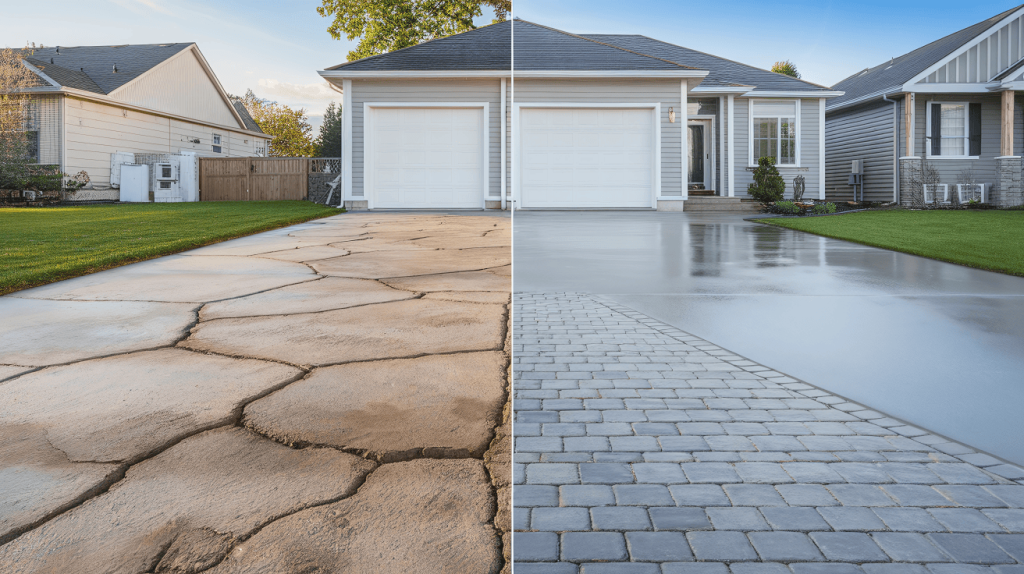
A cracked, stained, or worn driveway can detract from an otherwise well-maintained property. Once the damage begins to show up, however, homeowners may find themselves in a dilemma of whether to replace the driveway or treat the surface.
Concrete driveway resurfacing may be a sensible compromise. Rejuvenates the look and performance of an existing structurally sound driveway at lower cost and with less disruption than a complete replacement. But not all forms of damage can be treated with resurfacing.
This guide will help you determine when you should resurface your driveway, when it’s time to get a new one, and how to maintain your driveway to make it last longer.
What Is Concrete Driveway Resurfacing?
Concrete Driveway Resurfacing involves repairing and applying a new layer of special material to the top of an existing concrete driveway. Damaged sections are cleaned, repaired, and surface-treated prior to overlaying so that the new surface is able to bond properly.
Common surface problems that can be improved with the process include:
- Minor cracks
- Surface scaling
- Stains and discoloration
- Small holes and irregularities
- Weather-related wear
- Rough or uneven surface
Resurfacing is not the same as new concrete being poured over old concrete. It is important to prepare the surface properly. An overlay may only temporarily cover the problem if the underlying driveway has significant structural issues.
When is Resurfacing a Wise Investment?
Typically, when the foundation and structure of the driveway are stable, resurfacing is a good option.
The Damage Is Mostly Cosmetic
When there are surface cracks, stains, fading, and minor deterioration, it is often possible to fix these issues without removing the whole slab. The resurfaced driveway can be a wonderful method to overhaul the look of your driveway and also maintain the existing foundation.
Driveway has a Stable Foundation
One of the most important factors is a good starting point. If substantial sinking, movement, or general structural cracking is not observed, resurfacing can be an effective solution for a long period of time.
You Don’t Want to Pay for a Full Replacement.
Demolition, hauling, material costs, and added labor are all factors when removing and replacing concrete. If the existing driveway is structurally sound, resurfacing may be an option to limit the project scope.
The benefit lies in selecting the correct fix, instead of the default replacement.
When to Avoid Resurfacing?
Not all of the damaged driveways are good candidates for resurfacing. Overlying a new layer on serious underlying issues can result in recurring cracks and early failure.
Large cracks in the structure are present.
Any cracks that are wide, deep, or growing could be a sign of movement under the concrete. These issues should be assessed before resurfacing work.
Parts of the section are subsiding or uplifting.
Slabs that are not even can cause drainage problems and trip hazards. However, if there are substantial variations in elevation, the cause of the variation should be corrected, not covered over.
The Base Has Failed
The stability of the base is critical to concrete. If the soil movement, drainage, or base deterioration is continuing to cause damage, replacement or more extensive repairs may be a better long-term option.
If an honest evaluation is done before the project is begun, then money can not be spent on a solution that will not last.
What are the differences between Resurfacing and Asphalt Paving?
While both services provide the benefit of rejuvenating worn-out surfaces, there are some differences between concrete driveway resurfacing and Asphalt Paving Resurfacing in terms of materials used and maintenance requirements.
Typical asphalt resurfacing involves laying a new layer of asphalt over a well-prepared existing pavement. Can be a good choice for driveways and other large paved areas where the subbase is stable.
Concrete resurfacing involves the application of special overlays that will adhere to the concrete surface.
Several factors determine which is the best option:
- Existing driveway material
- Extent of damage
- Drainage conditions
- Traffic load
- Desired appearance
- Long-term maintenance expectations
When assessing the condition of their pavement systems, property owners need to think beyond only the pavement surface.
Will Concrete Driveway Seal Coating Prolong the Life of the Driveway?
Concrete Driveway Seal Coating can serve a protective role after repair or resurfacing to provide protection from moisture, stains, and environmental exposure.
A good sealer can offer advantages like:
- Reduced water penetration
- More stain-resistant qualities
- Easier surface cleaning
- Weatherproofing.
- Improved appearance
Seal coating is not a repair for structural damage. It is used instead as protective maintenance to be applied to already good concrete.
Oftentimes, the cost of regular maintenance is much cheaper than costly major repairs.
Could a Tar And Chip Driveway Be a Better Alternative?
Tar And Chip Driveway provides another appearance and building technique. It is a blend of liquid asphalt and loose aggregate that forms a textured surface, providing natural variation in appearance.
This is a great choice for rural homes, lengthy driveways, and those who would like an alternative to traditional asphalt or concrete.
Potential advantages include:
- Textured appearance
- Good traction
- Natural-looking finish
- Lighter look than regular paving.
But the proper material is dependent on the property conditions and use. By considering options, homeowners can choose a surface that aligns with their financial means and maintenance requirements.
Why is Drainage Important?
One of the leading causes of driveway problems is water. The deterioration, cracking, and weakness of the soil under the building can be due to poor drainage.
Before the resurfacing, it is crucial to search for:
- Standing water
- Water flowing towards the foundation.
- Driveway erosion.
- Water entering cracks
- Areas known as the surface has settled
Addressing drainage issues prior to resurfacing can greatly extend the life of the resurfacing.
How to Pick the Right Driveway Service?
Rather than one-size-fits-all for any property, the right contractor should assess the existing surface.
When researching paving companies, ask about:
- The condition of underlying base (s)
- Surface preparation methods
- Repair options before resurfacing
- Drainage concerns
- Expected maintenance requirements
- Suitable material alternatives
If you are a property owner who is considering hiring the services of Best Chip Seal Driveway services, resurfacing, asphalt work, or another type of pavement services, you need to understand the differences between the various materials.
A good recommendation shouldn’t be just about the fastest service to sell your home, but rather is based on your property’s condition.
Is it worth it to get Concrete Driveway Resurfacing?
Yes, when the driveway is structurally sound and the damage is only superficial, it may be worth it to get a concrete driveway resurfacing. It can make a thing look good, make it easier to use, and put off the time for a full replacement.
But resurfacing is not a shortcut to serious foundation issues, extensive movement, or failing concrete slabs.
The safest route to go is to begin with careful evaluation. In some cases, a specific repair and resurfacing project will suffice. In other cases, reapplication or an alternative like chip seal might be more cost-effective over the long term.
About Jim’s Paving & Chip Sealing
Jim’s Paving & Chip Sealing offers reliable services to homeowners seeking to enhance, repair, or maintain their driveways and paving. Whether it’s resurfacing, protective maintenance, chip seal, or paving, the team supports the customer in selecting the best solution for their property’s condition and requirements. A successful driveway project begins with knowing the surface, knowing the issues, and choosing an appropriate solution for long-lasting results. Contact us today.
Frequently Asked Questions
What is the life expectancy of concrete driveway resurfacing?
With surface preparation, weather exposure, traffic, drainage, and maintenance, a properly installed resurfaced driveway can last for years.
What’s the cost of a concrete driveway resurfacing?
In many cases, yes. Resurfacing can be less expensive due to the fact that there is no need for concrete demolition and replacement if the existing concrete is structurally sound.
Is it possible to resurface concrete that has severe cracks in it?
Cracks may be able to be patched before resurfacing. But if the cracks are very large or deep, more serious repairs may be necessary, or the entire unit might need to be replaced.
Will a concrete driveway need to be sealed after being resurfaced?
An appropriate protective sealer can be applied to help minimize moisture penetration, staining, and weather damage to the surface.
What is the difference between chip seal and concrete resurfacing?
Chip seal is a new textured surface formed with asphalt binder and aggregate, and concrete resurfacing is a new textured surface created on an existing concrete slab by the application of a special overlay.